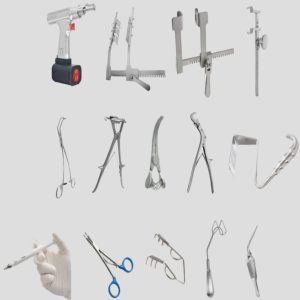
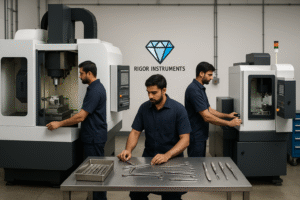
PAKISTANI MANUFACTURER OF SURGICAL INSTRUMENTS

Milling of Surgical instruments


Milling is a precision machining process that removes material from stainless steel blanks to achieve the exact shape, grooves, or fitting required in surgical instruments. Understanding the full scope of milling is crucial, as high-accuracy milling is essential to meet medical-grade performance, hygiene, and safety standards.


Why Accuracy in Milling Matters

1.  Instrument Functionality

  • Precise milling ensures jaws close tightly, scissors cut cleanly, and forceps align perfectly.

  • Even a 0.1 mm error can result in malfunction or failure during surgery.

2.  Fit & Assembly

  • Many surgical instruments are multi-part assemblies (e.g., forceps, clamps, rongeurs).

  • Accurate milling ensures perfect hinge alignment, smooth movement, and tight tolerances.

3.  Repeatability in Mass Production

  • CNC milling ensures every unit is identical across thousands of pieces.

  • Essential for batch consistency, especially when instruments are paired (e.g. matching jaws or jointed parts).

4.  Cleanability & Sterilization

  • Smooth, uniform milled surfaces prevent fluid buildup and bacterial colonization.

  • Sharp corners or inaccurate grooves can trap debris or resist sterilization.

5.  Surgeon Comfort & Performance

  • Ergonomically milled handles and grips improve precision handling, especially during long procedures.

  • Poorly milled parts lead to surgeon fatigue or instrument rejection.


 What Rigor Instruments Ensures

Precision Factor Rigor’s Practice
Tolerances Maintained within ±0.02 mm using 5-axis CNC milling
Tool Quality High-speed carbide tools with auto-calibration
Surface Finish Polished post-milling to reduce roughness (< Ra 0.4 μm)
Inspection 100% digital inspection of critical dimensions

 Risks of Poor Milling Accuracy

Problem Impact
Misaligned jaws Incomplete grasp, tissue trauma, or slippage
Uneven blade edges Dull cuts, bleeding risk, or surgical failure
Loose pivot joints Rattling instruments, imprecise motion
Sharp  Grooves Infection risk , Sterilization Failure

 Milling Machinery Used by Rigor Instruments

1. 5-Axis CNC Milling Machine

  • Brand/Model: HAAS UMC Series / DMG MORI

  • Purpose: Complex 3D contours, angled cuts on jaws, handles, and tips

  • Accuracy: ±0.01 mm

  • Use: Micro-serrations, ergonomic shaping, joint seat formation


2.  3-Axis Vertical CNC Milling Machines

  • Brand/Model: Fanuc / Mazak VCN Series

  • Purpose: High-speed precision flat milling and slotting

  • Use: Jaw edges, grooves, box locks, and screw seat milling

  • Features: Automatic tool changers, probing, and coolant systems


3. Mini CNC Milling Machines

  • Purpose: Ideal for small instruments (ophthalmic, dental, microsurgery tools)

  • Precision: ±0.005 mm

  • Use: Fine slots, hinge areas, and micro components


4.  High-Speed Dental Milling Units

  • Use: For high-accuracy dental tools and implant-grade parts

  • Material Compatibility: 420, 316L, titanium


5.  Wet Milling Systems

  • Purpose: Coolant-based systems to prevent heat stress during fine milling

  • Benefit: Maintains metal temper and smooth surface finish


6.  CNC-Controlled Jig Milling

  • Use: For guided drilling, slotting, and bridge cutting in complex assemblies

  • Advantage: Used for custom instrument development and prototyping


🔧 Rigor Instruments Milling Capabilities Summary

Machine Type Application Precision
5-Axis CNC Mill Complex shapes, angulated jaws ±0.01 mm
3-Axis Vertical Mill Flat faces, slots, and box locks ±0.02 mm
Mini CNC Mill Microsurgery & ophthalmic tools ±0.005 mm
Jig Mill Custom and modular component machining ±0.015 mm

SIGN UP FOR NEWSLETTER

Get a Quote