

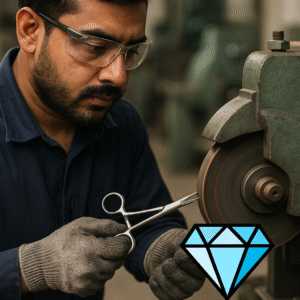
Outer Trimming & Ring Trimming in Forceps – Full Process
What Is Outer Trimming?
Outer trimming refers to shaping the outer contour of forceps, especially the handles, tips, and jaw area, after the forging stage.
Process:
-
Marking Template – A tracing guide or CNC program defines the forceps outline.
-
CNC Milling / Manual Grinding – Excess metal around the forged blank is trimmed away using:
-
Belt grinders
-
Rotary tools
-
High-speed burrs
-
-
Fine Shaping – Smooth curves, tapers, and joint edges are formed.
-
Polishing Prep – Trimmed areas are finished to reduce burrs or sharp transitions.
Purpose:
-
Achieve uniform outer dimensions
-
Prepare instrument for jointing and ring shaping
-
Ensure proper symmetry
What Is Ring Trimming?
Ring trimming focuses on refining the finger rings of forceps and scissors for:
-
Comfort
-
Size accuracy
-
Aesthetic symmetry
Process:
-
Initial Drilling – Finger holes are drilled to rough size (e.g., 16–20 mm).
-
Ring Cutting Dies or CNC – Tools are used to define the inner profile of the ring.
-
Hand Finishing / Lapping – Skilled craftsmen use files and rotary stones to:
-
Smooth inner ring walls
-
Remove burrs
-
Ensure ergonomic feel
-
-
Final Polish – Mirror finish applied to inner and outer ring surface
Rigor Instruments’ Expertise in Trimming Processes
Precision Engineering
-
CNC-controlled shaping ensures consistent geometry across batches.
-
Forceps are trimmed with tolerance of ±0.05 mm for exact matching in pairs.
Custom Ring Sizes
-
Available in standard and customized ring sizes for different surgical specialties (pediatric, plastic surgery, general, etc.)
Ergonomic Standards
-
Rigor ensures smooth, rounded inner ring edges to prevent finger fatigue.
-
Outer trimming shapes are validated by surgical technicians before production runs.
Quality Workflow
| Stage | Machine/Technique | QC Method |
|---|---|---|
| Outer Trimming | Belt Grinder + CNC | Shape template & digital caliper |
| Ring Punch & Trim | CNC lathe + manual filing | Ring gauge & manual inspection |
| Polishing & Finishing | Buffing wheels + vibro | Glove test & surface polish test |
General Precautions During Trimming
1. Maintain Symmetry
-
Ensure equal trimming on both halves of the forceps or scissors to prevent imbalance.
-
Use templates or CNC reference models for consistent shapes.
2. Avoid Over-Trimming
-
Removing too much material can:
-
Weaken the structure
-
Misalign joints
-
Lead to scrap loss
-
-
Operators must regularly measure during grinding or cutting.
3. Use Proper Tools
-
Always use sharp, well-maintained grinding and cutting tools.
-
Worn tools can cause burns, uneven surfaces, or chatter marks.
4. Prevent Heat Damage
-
Excessive grinding can generate heat, which:
-
Affects hardness and temper of stainless steel
-
Causes discoloration or micro-cracks
-
-
Use coolants or take breaks during prolonged trimming.
Safety & Handling Precautions
| Precaution | Why It’s Important |
|---|---|
| Wear cut-resistant gloves | Prevent injury from sharp edges or burrs |
| Use eye protection | Protect against flying metal shavings |
| Clamp instrument securely | Prevent kickback or tool slippage |
| Maintain clean workspace | Avoid mix-up or accidental damage of components |
Quality Control Precautions
-
Frequent Measurements: Use digital calipers and ring gauges after trimming
-
Visual Checks: Look for:
-
Sharp edges
-
Asymmetry
-
Burn marks
-
Surface roughness
-
-
Test Fit: Ensure the trimmed piece aligns properly with mating parts before assembly
How Rigor Instruments Ensures Safe Trimming
-
Skilled Craftsmen: All trimming is done by trained technicians with years of experience
-
Tool Calibration: Trimming tools are calibrated and maintained weekly
-
Standard Operating Procedures (SOPs): Followed strictly for every instrument category
-
Post-Trimming Inspection: Every piece is manually inspected and digitally logged