

Pickling of Surgical Instruments
Pickling is a chemical surface treatment process used to clean and prepare surgical instruments made of stainless steel. It removes oxide layers, welding scale, heat discoloration, and surface contaminants, ensuring the instrument is clean, corrosion-resistant, and biocompatible.
Why Pickling Is Important in Surgical Manufacturing
1. Removes Contaminants
-
Eliminates iron oxides, welding residue, and scale from forging or heat treatment
-
Prepares the surface for further finishing like passivation or electropolishing
2. Restores Corrosion Resistance
-
By removing surface impurities, pickling reactivates the chromium layer essential for stainless steel’s corrosion resistance
3. Improves Sterilization & Cleanability
-
A smooth, oxide-free surface is easier to clean and sterilize
-
Prevents bacterial buildup in microscopic crevices
4. Ensures a Uniform Finish
-
Produces a uniform matte or semi-bright surface
-
Removes discoloration or burn marks caused by heat
Typical Pickling Procedure for Surgical Instruments
| Step | Details |
|---|---|
| 1. Cleaning | Pre-clean with detergents to remove grease, oil, and dirt |
| 2. Acid Bath | Submerge in nitric + hydrofluoric acid solution (carefully controlled pH/temp) |
| 3. Rinsing | Rinse thoroughly with deionized water |
| 4. Neutralization | Optional alkali bath to remove acid residue |
| 5. Drying | Use hot air or vacuum drying to prevent water spots or rust |
How Rigor Instruments Ensures Safe Pickling
-
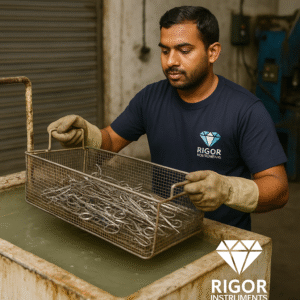
Uses automated acid tanks with stainless steel baskets
-
Conducts time-controlled immersion to avoid pitting
-
Neutralizes and rinses with ultra-pure deionized water
-
Trained workers follow strict PPE and chemical handling SOPs
-
Every batch undergoes post-pickling inspection under magnification
Risks of Improper Pickling
| Issue | Consequence |
|---|---|
| Overexposure to acid | Pitting, rough surfaces, or steel damage |
| Incomplete rinsing | Residual acid can cause corrosion or staining |
| Contaminated bath | Transfer of particles to other instruments |
| Poor drying | Water spots or flash rust |
Pickling Machinery Used by Rigor Instruments
1. Acid-Resistant Pickling Tanks
-
Material: High-density polypropylene (PP) or FRP (fiberglass-reinforced plastic)
-
Capacity: 200–1000 liters
-
Use: Immersion of forged/machined instruments in acid solution (HNO₃ + HF)
-
Features:
-
Acid circulation system
-
Splash guard covers
-
Ventilation hood for fume extraction
-
Fume Extraction System
-
Purpose: Safe removal of nitric/hydrofluoric acid vapors during pickling
-
Components:
-
Overhead ducting with chemical-resistant coating
-
Blowers with scrubber units
-
-
Importance: Protects workers and ensures OSHA-compliant air quality
Deionized Water Rinse Tanks
-
Material: Stainless steel or acid-resistant polymer
-
Function: Neutralize and rinse off acids after pickling
-
Features:
-
Continuous water circulation
-
Overflow system to ensure clean final rinse
-
Temperature-Controlled Acid Heating Units
-
Purpose: Maintain ideal pickling temperature (typically 40–60°C)
-
Benefits:
-
Accelerates oxide removal
-
Prevents overexposure and surface etching
-
Ultrasonic Cleaning Tanks (Post-Pickling)
-
Use: Final cleaning after pickling to remove micro-debris or acid residues
-
Frequency Range: 25–40 kHz
-
Tank Size: 50–300 liters depending on batch size
Neutralization Station
-
Use: Treat waste acid solutions before disposal
-
System Includes:
-
Chemical dosing tanks (alkali neutralizer)
-
pH monitoring system
-
Drainage tank for safe disposal
-
Summary Table
| Machine | Purpose | Key Features |
|---|---|---|
| Pickling Tank | Acid immersion cleaning | Polypropylene, temp control, vented lid |
| Deionized Rinse Tank | Post-acid rinse | Overflow, stainless or PP build |
| Ultrasonic Cleaner (optional) | Final residue removal | Gentle, precise, chemical-free cleaning |
| Fume Extractor & Scrubber | Safety & ventilation | Acid-resistant with filters |
| Neutralization Unit | Waste management | pH monitored, compliant disposal |