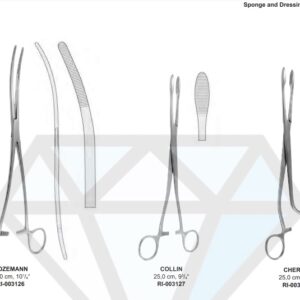


Rigor Instruments manufactures an extensive line of orthopedic surgical instruments designed to withstand the strength, precision, and repeated stress associated with bone and joint surgery procedures. Constructed of hardened surgical-grade stainless steel for increased durability and sharpness. Our instruments hold their edges well while remaining wear resistant so as to guarantee reliable performance throughout demanding procedures.
From bone-holding forceps and drills to saws and complete orthopedic surgical instrument sets, our catalog provides surgeons with all of the tools required for trauma, joint reconstruction and spinal procedures.
Orthopedic surgery covers a broad set of procedures, so this category brings together several distinct instrument families. The table below gives a quick overview before you browse the full catalogue.
| Instrument Type | Primary Use |
| Bone Rongeurs & Nibblers | Removing or trimming small sections of bone during joint and spine work |
| Periosteal Elevators | Separating periosteum from bone to expose the surgical site |
| Bone Curettes | Scraping bone or cartilage debris from joints and cavities |
| Bone Holding Forceps & Clamps | Gripping and stabilizing fracture fragments during fixation |
| Osteotomes & Bone Chisels | Cutting or shaping bone for grafts, fusions, and corrective surgery |
| Mallets | Providing controlled striking force for chisels, osteotomes, and implants |
| Bone Reduction Forceps | Aligning fractured bone segments before plating or screwing |
| Wire Twisters & Cutters | Managing orthopedic wire during tension-band and wiring techniques |
| Orthopedic Surgical Instrument Sets | Complete, pre-configured trays for specific procedures (fracture, joint, trauma) |
Orthopedic surgery concentrates on bone, cartilage as well as ligaments and joints. It's a physical problem which is distinct from soft-tissue procedures.. Bone is tough and unforgiving The tools employed to cut, grasp or shape it need to be more robust, sharper on the cutting edge and constructed to withstand the force of repeated use and often being struck by a mallet during the process. This is the difference that separates one with an orthopaedic surgical device from the standard surgical instrument. It's designed to handle load, not only accuracy.
An orthopedic tray typically incorporates a range of equipment that are working towards the same end goal -- opening up the bone, cutting or shaping the affected section, re-aligning fragments, and retaining the whole thing in place while it heals, or is fixed using screws, plates or wires. Instruments for surgery using manual orthopedics such as elevators, rongeurs and curettes are the foundation of all procedures, even though powered devices have become standard in larger hospitals because they provide surgeons with direct control of the instrument that motorized devices can't duplicate.
Rigor Instruments manufactures both individual pieces as well as complete orthopedic instruments, constructed from German or Japanese surgical-grade stainless steel (usually 420 or the 440 series) which is then tempered and hardened. bent to ensure that the edge is held throughout autoclave cycles repeatedly without discolouring or corroding. Every instrument is subject to grinding, forging, milling and hand-finishing steps, and then a final check for jaw alignment as well as spring tension (on the rongeurs and forceps) and polishing of the surface before it is packed for export.
Hospitals and distributors sourcing surgical instruments for orthopedic surgery are usually choosing between individual instruments and pre-built sets. Here's a simple framework we recommend to buyers:
| Procedure | Commonly Used Instruments |
| Fracture Fixation (ORIF) | Bone reduction forceps, periosteal elevators, drill guides, bone holding clamps |
| Joint Arthroplasty (Hip/Knee) | Bone rasps, osteotomes, bone hooks, retractors, mallets |
| Arthroscopic Procedures | Fine curettes, probes, graspers (see our dedicated arthroscopic range) |
| Spinal Surgery | Bone rongeurs, curettes, nerve root retractors, Kerrison punches |
| Trauma & Emergency Ortho | Wire twisters, bone cutters, reduction forceps, external fixation tools |
Quality & Certification Every instrument for orthopedic surgery that we make is manufactured in accordance with ISO 13485 and ISO 9001 quality management systems. They also have CE markings and FDA-registered facility status in line with the requirements of hospitals' procurement teams in the USA.
Export Experience: We regularly provide orthopedic surgical equipment and sets to surgical distributors, hospitals and dealers across the USA With a range of order sizes ranging from single trial trays up to full container shipping.
Custom & Private Label: OEM branding, logo engraving, and custom tray configuration are available for distributors who want to sell under their own name.
Direct-from-Factory Pricing: Since we are a manufacturer and not a trading businesswe are able to offer better pricing on the instruments for orthopedic surgery as well as complete sets.Frequently Asked Questions.
What steel is used in Rigor's orthopedic surgical instruments?We typically make use of German as well as Japanese surgical grade stainless steel (420/440 series) that is hardened to ensure long-term durability in the face of repeated bone contact and sterilization by autoclave.
Can you supply a complete orthopedic surgical instrument set for a specific procedure?
Yes — we build both standard and custom orthopedic surgical instrument sets configured for fracture, trauma, joint, and spine procedures based on your surgical team's preference card.
Do you supply veterinary orthopedic surgical instruments?
Yes, we manufacture scaled and adapted instrument sets for veterinary orthopedic use on request, alongside our standard human-surgery range.
Are these instruments suitable for teaching or training programs?
Yes — we offer simplified orthopedic instrument kits designed for surgical training labs and educational institutions.
What is your minimum order quantity for USA distributors
We mostly utilize German as well as Japanese surgical grade stainless steel (420/440 series) which is hardened to provide long-term durability in the face of repeated bone contact and sterilization by autoclave..