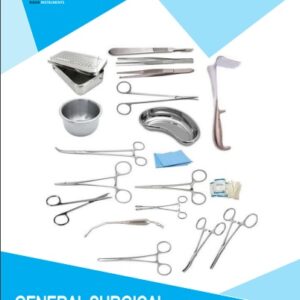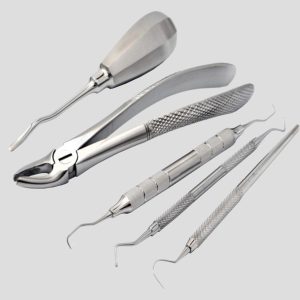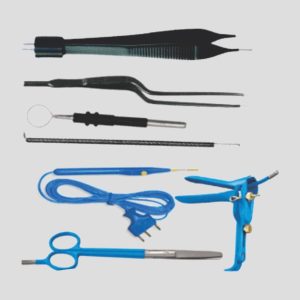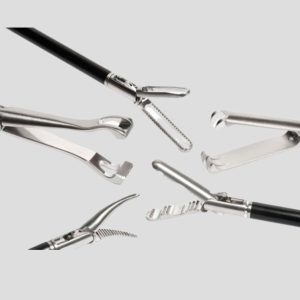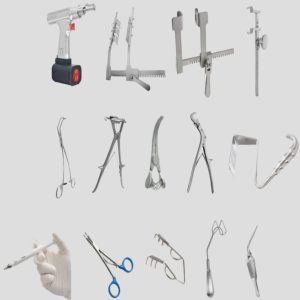


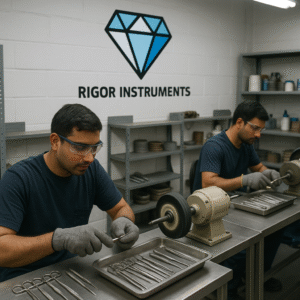
Rigor Instruments is globally renowned for its precision polishing of surgical instruments, a critical step that defines both aesthetic quality and medical-grade finish. With decades of experience and generations of skilled craftsmen, Rigor has become a world leader in polishing techniques.
Why Polishing Matters in Surgical Instruments
-
Enhances corrosion resistance
-
Ensures smooth, sterile surfaces
-
Prevents tissue damage during surgery
-
Improves grip and handling
Types of Polishing Techniques Used in Pakistan
1. Mirror Polishing
-
Produces a high-gloss, reflective finish
-
Common in instruments like scalpels, scissors, and retractors
-
Achieved through multi-stage buffing with fine abrasives
2. Matte or Satin Polishing
-
Non-reflective surface preferred in microsurgery and ophthalmic tools
-
Reduces glare under surgical lights
-
Achieved using abrasive wheels, sandblasting, or chemical dulling
3. Electropolishing
-
Electrochemical process that removes micro-debris and sharp points
-
Results in ultra-clean, smooth surfaces
-
Increases corrosion resistance and biocompatibility
4. Vibro Polishing (Tumble Polishing)
-
Used for mass processing of small components
-
Ensures uniform smoothness on bulk items
-
Common in dental and orthopedic implants
Rigor’s Competitive Strengths in Polishing
| Factor | Pakistan’s Advantage |
|---|---|
| Skilled Labor | Generations of craftsmen trained in manual and machine polishing |
| In-House Capabilities | Rigor Instruments polish internally |
| Export-Grade Quality | Complies with CE, ISO 13485, and FDA requirements |
| Cost-Effective Production | World-class finish at competitive rates |
| Custom Finishing Options | Matte, mirror, dual-finish, or branded polish available |
Quality Checks During Polishing
-
Visual inspection under magnification
-
Surface roughness tested (Ra < 0.4 µm for surgical finish)
-
Passivation testing (to confirm corrosion resistance post-polish)
-
Glove test to ensure no sharp burrs remain
Rigor Instruments – Polishing Machinery Lineup
1. Bench Polishing (Buffing) Machines
-
Type: Single & double spindle
-
Use: Final high-gloss mirror or matte finish on scissors, forceps, and clamps
-
Speed Control: Variable-speed motors (1,500–3,000 RPM)
-
Wheels: Cotton, sisal, felt, and leather buffs
-
Compatible Abrasives: White, green, or gray polishing compounds
2. Rotary Polishing Tools (Hand Buffers)
-
Type: Flexible shaft rotary tools (Foredom / Chinese equivalents)
-
Use: Detailed polishing of tight areas (box joints, serrated tips, finger rings)
-
Speed: Up to 20,000 RPM
-
Tools Used: Mounted felt wheels, cones, points, and brushes
3. Vibratory Polishing Machine (Vibro Finisher)
-
Use: Mass polishing of small parts like dental, ophthalmic, or bone screws
-
Media: Ceramic, plastic, or stainless polishing chips with compounds
-
Tank Size: 50–300 L capacity
-
Cycle Time: 30–120 minutes per batch
4. Belt Grinding & Satin Finishing Machines
-
Use: Matte or satin finishing on handles and shafts
-
Belts Used: 180 to 600 grit
-
Features: Adjustable contact wheels and angle guides
5. Ultrasonic Cleaning Units (Post-Polishing)
-
Use: Remove polishing compound residue and fine metal dust
-
Tank Size: 25–100 L
-
Frequency: 25–40 kHz for deep cleaning of micro-crevices
-
Cycle Time: 5–20 minutes
6. Dust Extraction & Filtration System
-
Purpose: Capture polishing dust and metal particles for operator safety
-
Includes:
-
Central vacuum hood
-
Replaceable HEPA filters
-
Aluminum dust collectors near buffing wheels
-
Machinery Summary Table
| Machine | Function | Key Feature |
|---|---|---|
| Bench Buffing Machine | Final surface finishing | High-speed with twin spindles |
| Hand Rotary Polisher | Precision polish in joints/rings | Flexible shaft and micro-bits |
| Vibro Polishing Unit | Mass uniform polishing | Uses polishing media and slurry |
| Belt Satin Finisher | Matte/brushed finish creation | Adjustable grits and pressure |
| Ultrasonic Cleaner | Post-polish cleaning | Removes compound & micro-particles |
| Dust Collector System | Safety and cleanliness | HEPA filters and quiet operation |