

Sandblasting Surgical Instruments – Pros vs Cons
| ✅ Pros | ❌ Cons |
|---|---|
| Improves grip by creating a textured surface (ideal for handles and non-slip tools) | May reduce corrosion resistance if not followed by proper passivation |
| Removes oils, rust, and polishing residues effectively | Can cause micropitting or surface micro-cracks if too aggressive |
| Creates a uniform matte finish for a professional look | Not suitable for sharp edges, which can be dulled unless masked |
| Prepares the surface for plasma coating, gold plating, or anodizing | Requires post-blast ultrasonic cleaning to remove embedded particles |
| Environmentally friendly compared to chemical etching | Inconsistent results if outsourced to non-specialized vendors |
| Customizable texture based on media type and pressure control | Additional QA steps needed to ensure particle-free, sterile finish |
At Rigor Instruments
-
We sandblast only in-house, using medical-grade abrasive media
-
It’s applied selectively (e.g., on handles, not blades)
-
Each instrument is cleaned, passivated, and inspected post-blasting
-
Fully traceable under ISO 13485 compliance
Machinery & Materials Used in Sandblasting at Rigor Instruments
Sandblasting is a key surface treatment step in surgical instrument manufacturing. At Rigor Instruments, we use specialized in-house equipment and medical-grade abrasive media to ensure safe, consistent, and high-quality matte finishes.
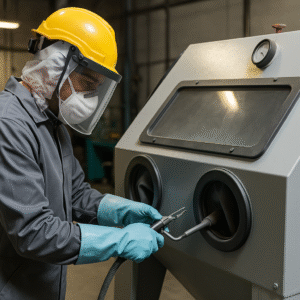
1. Sandblasting Cabinet / Chamber
-
Type: Pressure-fed or suction-fed enclosed cabinet
-
Material: Corrosion-resistant stainless steel or powder-coated steel
-
Features:
-
Built-in gloves and vision window
-
Foot pedal control for blasting
-
Internal lighting for visibility
-
Dust extraction system for safety
-
-
Use: Allows clean, contained blasting of delicate and precision instruments
2. Air Compressor Unit
-
Capacity: 5–10 HP (Horsepower), with 100–150 PSI pressure
-
Tank Volume: 100–300 liters
-
Purpose: Provides steady, high-pressure airflow to propel abrasive media
-
With: Moisture trap and air filter to avoid contaminating the media
3. Abrasive Media (Medical-Grade)
| Media Type | Description | Use Case |
|---|---|---|
| Aluminum Oxide (White) | Sharp, hard particles for aggressive surface prep | General instruments, orthopedic tools |
| Glass Beads | Rounded media for soft matte finish | Ophthalmic or microsurgical tools |
| Silicon Carbide (Rare) | Ultra-hard media for specialty applications | Only for specific coated tools |
| Plastic Media (Optional) | Softer for delicate components | Pediatric or fine-tip tools |
All media used at Rigor are sterile-compatible, non-toxic, and free from heavy metals.
4. Nozzles & Blast Gun
-
Material: Tungsten carbide or boron carbide
-
Size: 3–8 mm depending on required precision
-
Control: Adjustable flow and angle to suit tool shape
-
Mounted to: Manually operated blast gun with foot pedal or automatic timer
5. Dust Collector / Filtration System
-
HEPA filters for airborne dust
-
Ensures clean air environment inside the cabinet
-
Protects both the worker and the instrument’s surface from contamination
Rigor Instruments’ Safety & QA Controls
-
Only trained operators handle blasting operations
-
Instruments are inspected post-blasting
-
Each batch is sent immediately to ultrasonic cleaning and passivation
-
All processes are recorded under ISO 13485 traceability protocols
Please visit the link below for the process following Sandblasting